
Categories
- Billy Bladez Custom Conjure Ancient Civilizations
- Billy Bladez Custom Conjure Extraterrestrials
- Billy Bladez Custom Conjure Multi-Dimensionals
- Billy Bladez Custom Conjure Orphans
- Billy Bladez Custom Conjure Pre-Historics
- Billy Bladez Custom Conjure Spirits for the Youngsters
- Billy Bladez Custom Conjure Totem Animals
- Billy Bladez Custom Conjure Yokai
- Billy Bladez Custom Conjured Angels
- Billy Bladez Custom Conjured Black Arts Companions
- Billy Bladez Custom Conjured Creatures
- Billy Bladez Custom Conjured Demons
- Billy Bladez Custom Conjured Djinn
- Billy Bladez Custom Conjured Dragons
- Billy Bladez Custom Conjured Elementals
- Billy Bladez Custom Conjured Elves
- Billy Bladez Custom Conjured Fae
- Billy Bladez Custom Conjured Gifted Humans
- Billy Bladez Custom Conjured Mer-Folk and Sea and Water Spirits
- Billy Bladez Custom Conjured Non-Categorized Spirit Listings
- Billy Bladez Custom Conjured Portals to the Immortals
- Billy Bladez Custom Conjured Sexual Spirits
- Billy Bladez Custom Conjured Vampires
- Billy Bladez Custom Conjured Were-Creatures,Shifters and Hybrids
- Billy Bladez Exclusive Spirit Conjures
- Billy Bladez Multi Spirit Special Custom Listings
- Billy Bladez Pre-Conjured Black Arts Beings/Pics Included
- Billy Bladez Pre-Conjured WA/DA Companions w/ Pic Included
- Billy Bladez Pre-Done Astral Landscapes
- Billy Bladez Reiki Healing Services
- Billy Bladez Resellers Listings
- Billy Bladez Samhain/Halloween Conjures
- Billy Bladez Spirit Keeping Education Center & Resources
- Billy Bladez Spirit order Add-On Listings and Readings
- Billy Bladez Triad Spirit Listing
- Custom Conjures by Archelone AKA The Grey Mage
- Hand-Crafted Spelled Spirit Charging/Offering boxes
- Hecate's Mystical Boutique
- Pre-Conjure Reviews
- Spirit Add-Ons
- Support the Circle
- Tarot Readings by Moon Walker Master Tarot Reader
- The Complete Beginners Guide To Spirit Keeping by Billy Bladez
- Featured Products ...
- All Products ...
New Products [more]

Custom Conjure Druid
Sale: $10.00
Save: 94% off

Custom Conjure Dullahan
Sale: $10.00
Save: 94% off

Custom Conjure Duojna
Sale: $10.00
Save: 94% off


Featured [more]

Custom Conjure Stegosaurus
Sale: $10.00
Save: 94% off

Custom Conjure WA Pegasus
Sale: $10.00
Save: 94% off
How to Read Tarot Spreads With Clear Intuition
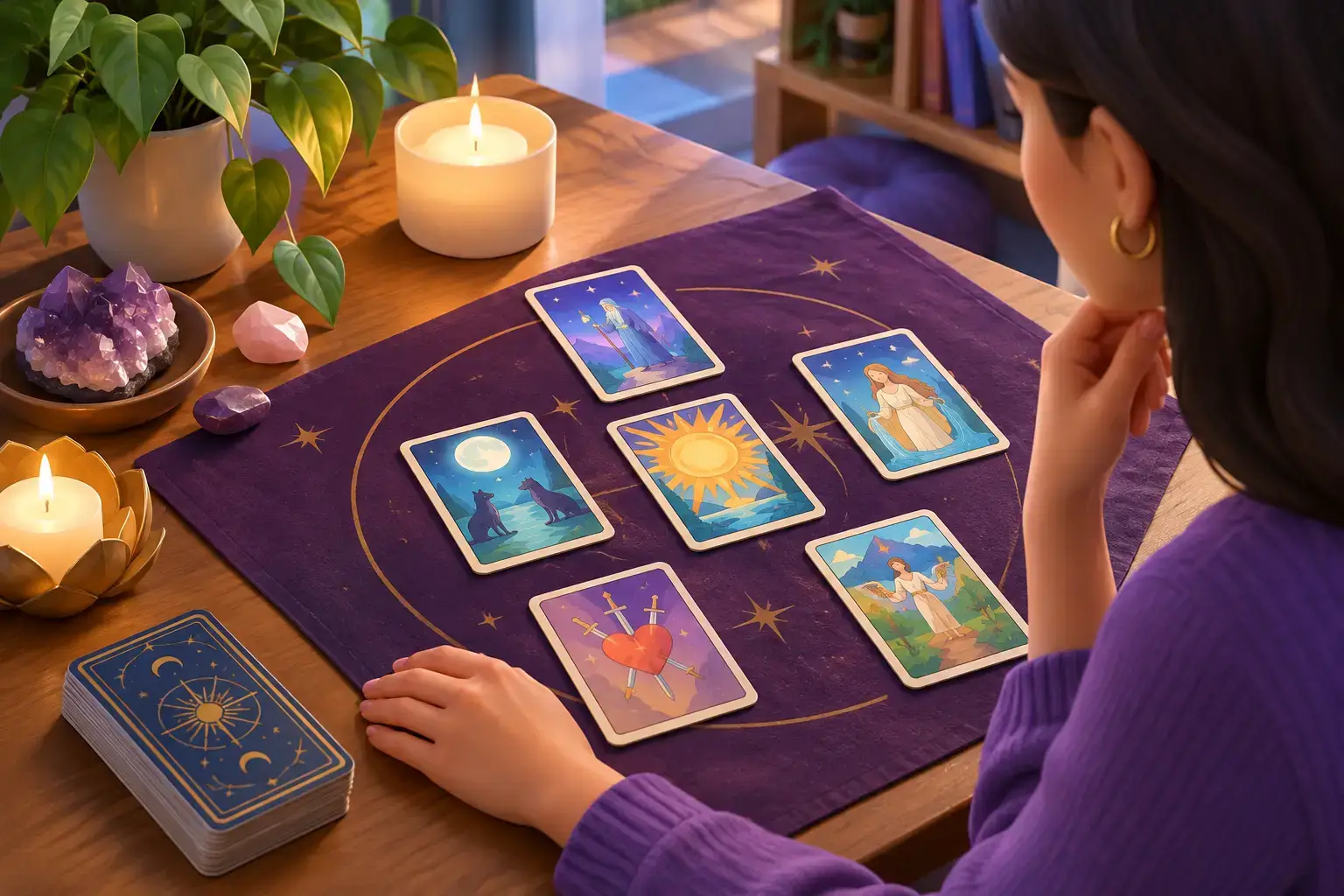
A tarot spread is not a test you pass by memorizing 78 fixed meanings. It is a conversation arranged in space. When you learn how to read tarot spreads, the real shift comes from seeing how each card speaks through its position, its neighbors, and the question placed at the center of the reading.
For spirit keepers, energy workers, and pagan practitioners, a spread can also become a focused ritual container. It gives your intuition somewhere to land. Whether you are asking about protection, a crossroads in love, a companion’s support, or the energetic root of a repeating pattern, the cards are most useful when you read them as a living message rather than isolated symbols.
Begin With a Question That Has Energy
A vague question creates a vague reading. “What will happen to me?” can pull the entire deck into a fog. Instead, ask what you need to understand, choose, heal, or work with now.
Try questions such as, “What energy is influencing my protection work this month?” or “What truth am I avoiding in this connection?” A question does not need to be painfully specific, but it should give the spread a clear current. The cards are not there to hand over every detail of a predetermined future. They reveal themes, choices, inner dynamics, likely momentum, and areas where your own action matters.
Before shuffling, take a moment to settle your field. Light a candle, touch a protective charm, hold a crystal, say a brief prayer, or simply place both feet on the floor. If you work with spiritual companions or ancestors, you may respectfully invite supportive guidance aligned with your highest good. Clear boundaries matter. Ask for insight, not interference; clarity, not fear.
Read the Position Before the Card
This is the foundation of how to read tarot spreads well: the position tells you what role a card is playing. The same card can offer entirely different guidance depending on where it lands.
Imagine pulling the Five of Pentacles. In a position labeled “What you fear,” it may reveal anxiety around lack, rejection, or being left without support. In “What needs healing,” it can point to an old scarcity wound or a place where it is time to accept help. In “Likely outcome,” it might be a gentle warning to budget energy, money, or emotional labor before a situation becomes draining.
Read the spread layout first. If you are using a three-card spread, decide what each space means before you pull: situation, challenge, and guidance; past, present, and emerging path; mind, body, and spirit. Do not change the positions halfway through simply because a card makes you uncomfortable. Let the structure hold the reading steady.
A larger spread offers more nuance, but it also asks more of your focus. Beginners often receive more accurate, useful guidance from three to five intentional positions than from a ten-card layout they cannot yet synthesize. Complexity is not the same as depth.
Let the Cards Speak to One Another
A spread is a sentence, sometimes a whole story. Once you have looked at each position individually, step back and notice the relationships between cards.
Start with the emotional temperature. Are Cups everywhere, suggesting feeling, connection, desire, grief, or intuitive movement? Are Swords dominating, showing mental pressure, communication, conflict, discernment, or a hard truth? A field heavy with Wands may be charged with action, passion, spiritual will, and restlessness. Pentacles often bring the reading into the physical realm: resources, health, home, work, stability, and long-term cultivation.
Then watch for repetitions. Several Major Arcana cards suggest a larger turning point or soul-level lesson, while a court card may describe a person, a personality pattern, or an aspect of you that needs to lead. Repeating numbers can be equally revealing. Multiple twos may emphasize balance and choices; several nines can point to culmination, solitude, or a threshold before release.
Contrast matters, too. The Sun beside the Eight of Swords does not cancel the restriction. It may show that relief becomes available once you recognize the cage is partly made of belief. The Tower beside the Star can describe disruption followed by spiritual renewal. Tarot rarely speaks in one-note declarations. Let tension remain where it belongs instead of forcing every spread into a comforting answer.
Use Your First Impression, Then Verify It
The first feeling you receive from a card is often valuable. Perhaps the Queen of Cups feels protective rather than romantic. Perhaps the Death card brings relief, not dread. Notice the immediate image, body sensation, memory, color, or phrase that rises before reaching for a guidebook.
Then verify that impression through the card’s traditional symbolism and spread position. Intuition without any framework can become projection. A rigid framework without intuition can become lifeless recitation. The strongest readings honor both.
If you are reading for yourself, be especially alert to the answer you wanted before you shuffled. A tarot deck can reflect hope, fear, and avoidance with uncomfortable precision. When a message feels charged, write down the card, position, and your initial reaction before interpreting further. Returning to your notes later often reveals what you could not see in the moment.
Reversals Are a Tool, Not a Requirement
Reversed cards can add texture, but they are not mandatory. Some readers use them to show blocked energy, an internal process, delay, resistance, imbalance, or an alternative expression of the upright card. Others read every card upright and find plenty of nuance through position and surrounding cards.
Choose one approach for a reading and stay consistent. If you use reversals, avoid treating every reversed card as negative. A reversed Devil may indicate loosening a harmful attachment. A reversed Hermit can suggest re-entering community after a necessary period of solitude. Context decides the message.
If reversals leave you second-guessing every pull, set them aside for now. Your practice should build discernment, not make you afraid to touch the deck.
A Simple Spread for Clear Guidance
When emotions are high, use a spread that is small enough to read honestly. Lay three cards from left to right:
- What is present - the energy, truth, or pattern active now.
- What is influencing it - the hidden factor, lesson, wound, support, or pressure beneath the surface.
- What supports my next step - the most constructive action, attitude, boundary, or spiritual practice.
Suppose you ask about feeling blocked in your psychic development and pull the High Priestess, the Nine of Swords, and the Page of Wands. The High Priestess in the present position suggests intuitive sensitivity is already present. The Nine of Swords as influence may reveal anxiety, overthinking, or fear of getting it wrong. The Page of Wands as support encourages experimentation, curiosity, and a small brave practice rather than waiting for perfect certainty.
Notice that this is more useful than declaring, “You are psychic” or “You are blocked.” The spread points toward a relationship with your own energy and gives you a workable next move.
Know When to Stop Pulling Cards
One of the most overlooked tarot skills is knowing when the reading is complete. Pulling clarification card after clarification card can muddy a message that was already clear. Often, the urge to keep drawing comes from discomfort with the answer rather than a genuine need for more information.
If a card truly feels unclear, pull one clarifier with a defined purpose: “What aspect of this card needs attention?” Read it beside the original card, not as a replacement. If the message remains confusing, close the deck and return later. Time, dreams, ritual work, and ordinary life experience may supply the missing context.
After the reading, record the date, question, layout, cards, and key impressions. Include what you plan to do with the guidance. Tarot becomes far more powerful when you can see patterns across weeks or months: the boundaries you kept avoiding, the protection work that steadied you, the invitation that kept returning.
Let your spread be a mirror, a map, and a moment of sacred honesty. You do not need to force certainty from every card. Sit with the symbols, honor your discernment, and take the next aligned step that feels true in both your intuition and your lived reality.

Important Links
- Spirit Companion Codex
- The PaganShopOnline.com's Circle of Conjurors
- The PaganShopOnline.com's FAQ's
- Transparency in Spirit Conjuring: Ethics, AI and Integrity
- Spirit Matching Quiz ( Help Find the Best Beings for You)
- Pagan Shop Online Chatroom
- The Pagan Shop Online Forum
- ThePaganShopOnline's Blog
- The Conjuror’s Eye: An Exclusive Pagan Shop Experience
- The Conjuror's Deck: An Exclusive Pagan Shop Experience
- The Conjurors Insight: An Exlusive Pagan Shop Experience
- The Conjuror's Oracle: An Exclusive Pagan Shop Experience
- The Conjuror's Board: An Exclusive Pagan Shop Experience
- The Conjuror's Numerology Matrix An Exclusive PS Experience
- The Conjuror's Stones An Exclusive Pagan Shop Experience
- The Conjuror's Horoscope An Exclusive Pagan Shop Experience
- The Conjuror's Mirror A Exclusive Pagan Shop Experience
- The Conjuror's Dream Interpreter An Exclusive P. Shop Experience
- Sigil Maker
Reward Points
Log in to see how many reward points you have already earned
Sponsors
 |
Bestsellers
- In-Depth Reading of your spirit
- Custom Conjure Royal(Monarch)...
- Spirit Picture Upgrade From Basic...
- Custom Conjure Bound DA Spirit or...
- DA/WA Spirit/Entity Reverse...
- Ultimate Add On Spirit Package
- 3 body Binding Add-On Spirit,Astral...
- 2 body Spirit Binding
- Reverse Adoption for Gifted Humans
- Free Good Luck Spell