
Categories
- Billy Bladez Custom Conjure Ancient Civilizations
- Billy Bladez Custom Conjure Extraterrestrials
- Billy Bladez Custom Conjure Multi-Dimensionals
- Billy Bladez Custom Conjure Orphans
- Billy Bladez Custom Conjure Pre-Historics
- Billy Bladez Custom Conjure Spirits for the Youngsters
- Billy Bladez Custom Conjure Totem Animals
- Billy Bladez Custom Conjure Yokai
- Billy Bladez Custom Conjured Angels
- Billy Bladez Custom Conjured Black Arts Companions
- Billy Bladez Custom Conjured Creatures
- Billy Bladez Custom Conjured Demons
- Billy Bladez Custom Conjured Djinn
- Billy Bladez Custom Conjured Dragons
- Billy Bladez Custom Conjured Elementals
- Billy Bladez Custom Conjured Elves
- Billy Bladez Custom Conjured Fae
- Billy Bladez Custom Conjured Gifted Humans
- Billy Bladez Custom Conjured Mer-Folk and Sea and Water Spirits
- Billy Bladez Custom Conjured Non-Categorized Spirit Listings
- Billy Bladez Custom Conjured Portals to the Immortals
- Billy Bladez Custom Conjured Sexual Spirits
- Billy Bladez Custom Conjured Vampires
- Billy Bladez Custom Conjured Were-Creatures,Shifters and Hybrids
- Billy Bladez Exclusive Spirit Conjures
- Billy Bladez Multi Spirit Special Custom Listings
- Billy Bladez Pre-Conjured Black Arts Beings/Pics Included
- Billy Bladez Pre-Conjured WA/DA Companions w/ Pic Included
- Billy Bladez Pre-Done Astral Landscapes
- Billy Bladez Reiki Healing Services
- Billy Bladez Resellers Listings
- Billy Bladez Spirit Keeping Education Center & Resources
- Billy Bladez Spirit order Add-On Listings and Readings
- Billy Bladez Triad Spirit Listing
- Custom Conjures by Archelone AKA The Grey Mage
- Hand-Crafted Spelled Spirit Charging/Offering boxes
- Hecate's Mystical Boutique
- Pre-Conjure Reviews
- Support the Circle
- Tarot Readings by Moon Walker Master Tarot Reader
- The Complete Beginners Guide To Spirit Keeping by Billy Bladez
- Featured Products ...
- All Products ...
New Products [more]

Pre-Conjure Woodland Elf
Sale: $5.00
Save: 97% off

Pre-Conjure Wolf Totem Spirit
Sale: $5.00
Save: 97% off

Pre-Conjure Wood Elf
Sale: $5.00
Save: 97% off


Featured [more]
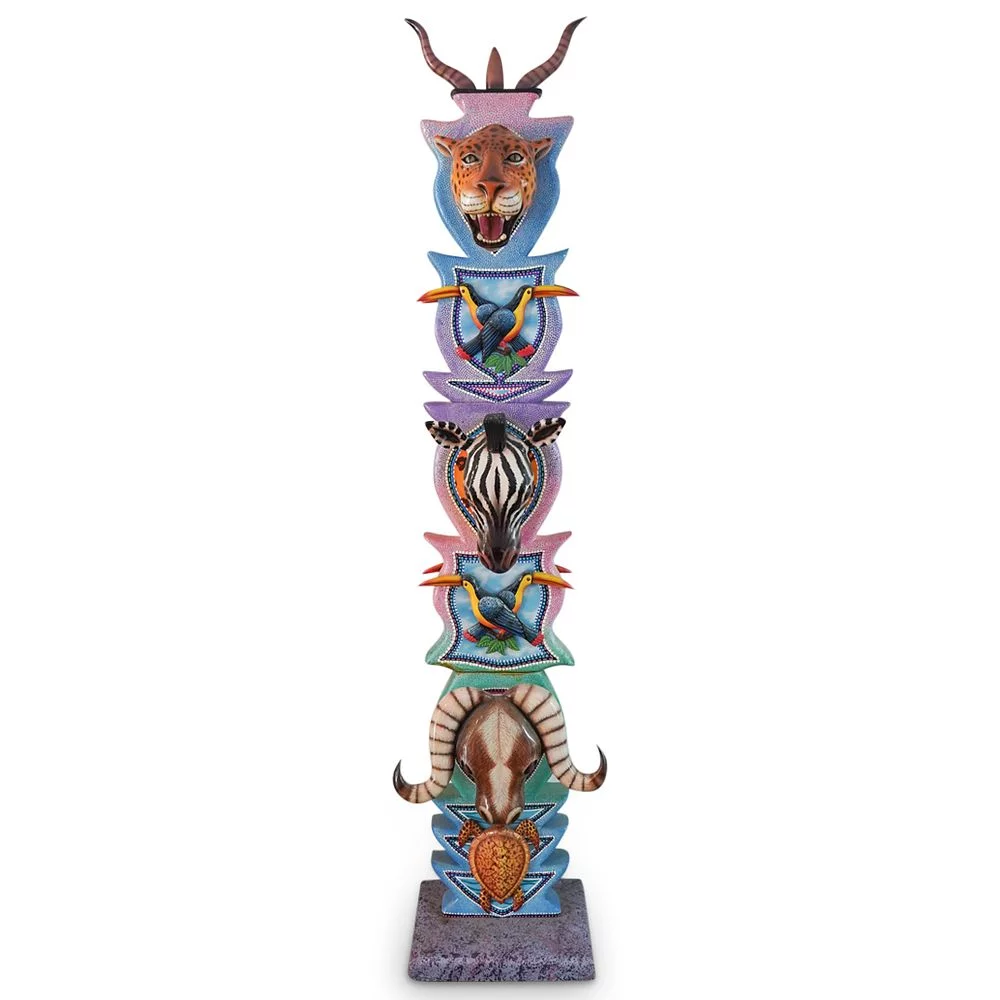
Reverse Adoption of Totem Animal
Sale: $10.00
Save: 94% off

Custom Conjure Wooly Mammoth
Sale: $10.00
Save: 94% off
Spirit Offering Types: Find Your Right Path
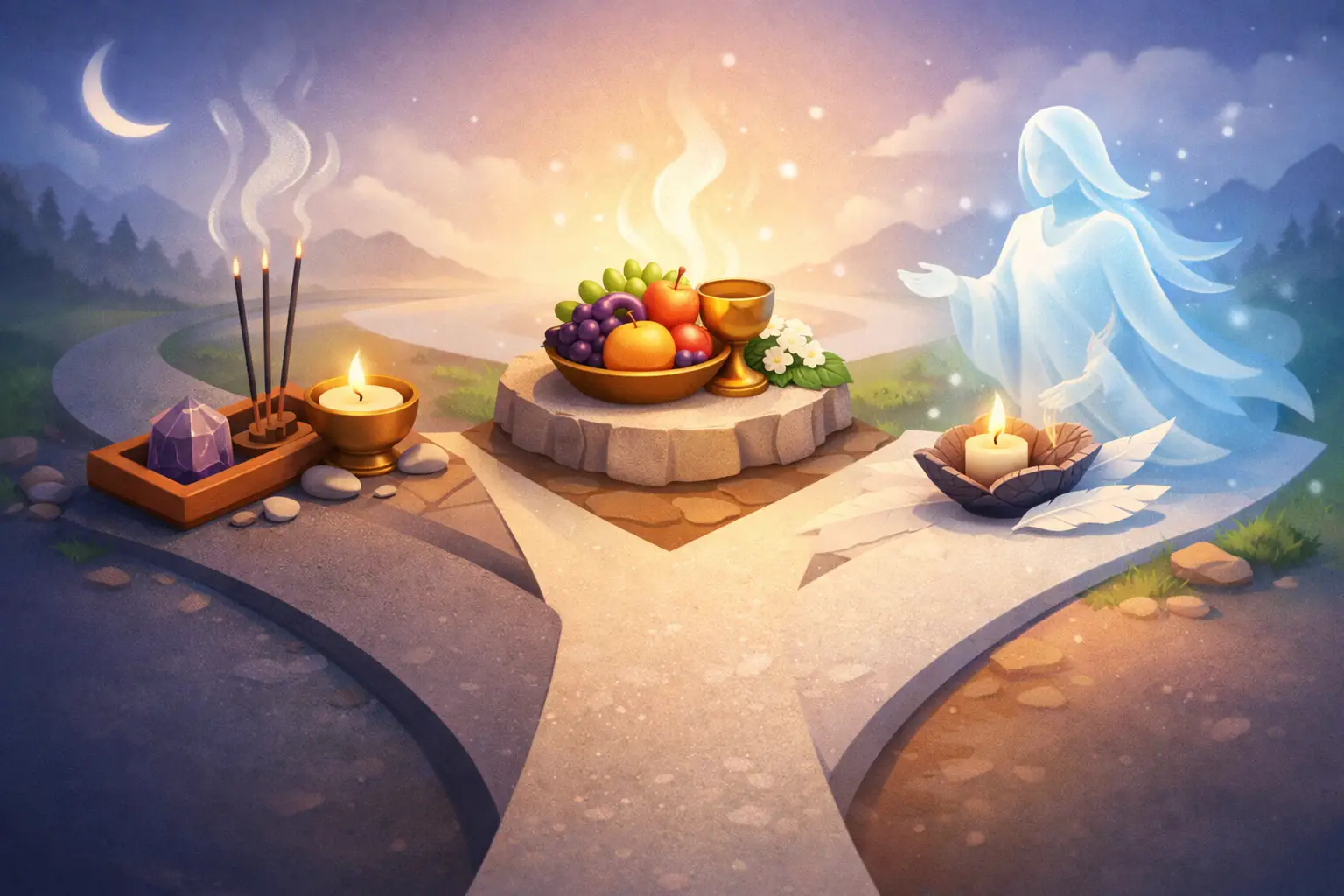
A spirit altar should feel alive, not crowded with items chosen from obligation. The most meaningful spirit offering types are not necessarily expensive, rare, or elaborate. They are intentional gestures that reflect the nature of the companion or deity you honor, the relationship you are building, and the boundaries of your own practice. A clean glass of water offered with presence can carry more devotional weight than an overflowing altar assembled without focus.
For spirit keepers, offerings create a rhythm of acknowledgment. They can mark a new binding, welcome a newly arrived companion, support ritual work, or simply say, “You have a place here.” There is no single offering that suits every being. A protective dragon, a courtly fae, an ancestral presence, and a celestial companion may each respond to very different symbols, scents, activities, or energetic currents.
Spirit Offering Types and What They Express
Think of an offering as a language. You are communicating gratitude, respect, invitation, celebration, or a request for support. The form matters less than the clarity behind it, though correspondences can help you choose a gift that feels aligned rather than random.
Light, flame, and candle offerings
Candles are among the most familiar offerings because flame gives visible form to attention. A tea light lit during meditation can become a simple devotional bridge, while a colored candle can support a specific intention. White often suits purification, peace, and open-ended reverence. Red may be chosen for passion, vitality, courage, or a fierce protective current. Green can complement prosperity and growth work, while blue may support healing, calm, and psychic reflection.
Use fire thoughtfully. Never leave a candle unattended, and do not assume a spirit requires a flame to receive your respect. For homes where open fire is not practical, an electric candle, a small lamp, or even a moment spent watching dawn can serve the same symbolic purpose.
Water, libations, and refreshment
Fresh water is one of the most versatile offerings in spirit work. It is humble, cleansing, and accessible, which makes it especially fitting for beginners who want to establish a consistent altar practice. Place it in a dedicated cup or glass, refresh it regularly, and treat the act of changing it as part of your connection.
Libations may also include tea, coffee, wine, juice, milk, or other beverages that fit your path and the companion’s known preferences. This is an area where discernment matters. If alcohol does not belong in your home, recovery, faith, or personal boundaries, there is no need to force it into a ritual. Herbal tea, spiced water, or a favorite nonalcoholic drink can be equally personal.
Food and natural gifts
Food offerings are often associated with hospitality and celebration. Fruit, bread, honey, chocolate, nuts, herbs, spices, and sweets can be selected for their symbolism or simple heartfelt relevance. A kitchen witch may offer a pinch of freshly ground cinnamon during prosperity work. Someone working with a warm, nurturing companion might set out a small piece of baked bread or seasonal fruit.
Natural gifts bring the altar into conversation with the living world. Flowers, leaves, shells, feathers found ethically outdoors, stones, seeds, and small branches can be beautiful choices. Avoid taking from protected areas or disturbing wildlife. Also avoid leaving food outdoors if it could harm animals, attract pests, or violate local rules. An offering should not create trouble for the land around you.
Incense, oils, and scent offerings
Scent can shift the entire atmosphere of a space within minutes. Incense, resin, loose herbs, essential oil diffusers, and perfume oils are popular options for spirit keepers who work through sensory ritual. Frankincense may suit prayerful or elevating work; sandalwood can create a grounded, meditative atmosphere; rose may complement love, beauty, and heart-centered devotion.
Still, correspondence charts are only a starting point. If a scent gives you a headache, triggers allergies, or is unsafe for children or pets, it is not the right offering for your household. Choose a smokeless alternative, open a window, play a sound offering, or offer the energy of the scent through visualization. Respect for your physical space is part of respect for your spiritual work.
Creative and devotional offerings
Not every offering belongs on an altar. A poem written for a companion, a song played in private, a drawing, a dance, or a handmade charm can be deeply personal. These offerings are especially powerful when you want to move beyond purchasing objects and build a relationship through your own time and energy.
Devotional action can be just as meaningful. You might dedicate a walk in nature, a period of study, a cleansing bath, a charitable act, or a difficult but necessary boundary to a spirit whose presence supports your growth. If you work with a companion connected to justice, for example, an offering could be the honest action you have been avoiding. For a healing-focused ally, it may be keeping a therapy appointment, resting without guilt, or tending to your body with more care.
Crystals, talismans, and altar objects
Crystals and symbolic objects make lasting offerings because they can remain on an altar or in a dedicated vessel. Clear quartz, amethyst, obsidian, citrine, moonstone, and hematite are common choices, but their value is not limited to a standard meaning. A stone collected on a meaningful trip or a key from a former home may hold stronger personal resonance than a trendy crystal selected from a chart.
Talismans are useful when your relationship with a companion is connected to a defined intention, such as protection, dream work, confidence, luck, or psychic development. You may dedicate an object during ritual, keep it near the binding vessel, or carry it when appropriate. Be clear about its purpose and avoid turning every spiritual connection into a demand for constant results.
How to Choose an Offering for a Spirit Companion
Begin with what is known about the being’s energy, culture, element, personality, and preferred offerings, if that information has been shared through the conjuration. Then bring in your own intuitive response. A companion may be associated with moonlight, but if every full-moon ritual leaves you depleted, a quiet water offering on another evening may be the better choice.
Ask practical questions alongside mystical ones. Can you safely maintain this offering? Will it spoil? Is it respectful to your household? Does it fit the boundaries you set around your altar? Consistency is more valuable than grand gestures that cannot be sustained.
For a new spirit keeper, start with one or two simple offerings for a few weeks. Keep a private journal of dreams, moods, ritual impressions, synchronicities, and changes in your own attention. Do not strain to interpret every event as a sign. Relationship building benefits from patience, grounded observation, and room for ordinary life to remain ordinary.
Timing, Disposal, and Respectful Boundaries
Some practitioners offer daily. Others work weekly, on moon phases, during seasonal festivals, or when beginning a particular spell or meditation. The right frequency depends on your tradition, schedule, and the type of connection you are cultivating. An offering becomes more meaningful when it is freely given, not performed from fear that you will offend a companion by missing a day.
Refresh water and food before they become stale. Once an offering has completed its purpose, dispose of it respectfully according to its material and your local environment. Compost biodegradable items when appropriate, pour plain water into soil or down the sink with thanks, and discard candles or packaging safely. Do not release wax, oils, salt, crystals, or food into waterways or public land.
Your altar also needs boundaries. Keep offerings out of reach of pets and children, do not burn materials in unsafe conditions, and do not let spiritual practice override financial, medical, legal, or mental health support when those forms of care are needed. Strong spirit keeping is not about surrendering your judgment. It is about strengthening your presence, discernment, and personal authority.
The Pagan Shop Online approaches spiritual companionship as an individual path, and that same principle applies at the altar. Let your offerings become a living conversation rather than a performance. Start small, notice what feels sincere, and allow each respectful act to deepen the sacred atmosphere you are creating around your life.

Important Links
- Spirit Companion Codex
- The PaganShopOnline.com's Circle of Conjurors
- The PaganShopOnline.com's FAQ's
- Transparency in Spirit Conjuring: Ethics, AI and Integrity
- Spirit Matching Quiz ( Help Find the Best Beings for You)
- Pagan Shop Online Chatroom
- The Pagan Shop Online Forum
- ThePaganShopOnline's Blog
- The Conjuror’s Eye: An Exclusive Pagan Shop Experience
- The Conjuror's Deck: An Exclusive Pagan Shop Experience
- The Conjurors Insight: An Exlusive Pagan Shop Experience
- The Conjuror's Oracle: An Exclusive Pagan Shop Experience
- The Conjuror's Board: An Exclusive Pagan Shop Experience
- The Conjuror's Numerology Matrix An Exclusive PS Experience
- The Conjuror's Stones An Exclusive Pagan Shop Experience
- The Conjuror's Horoscope An Exclusive Pagan Shop Experience
- The Conjuror's Mirror A Exclusive Pagan Shop Experience
- The Conjuror's Dream Interpreter An Exclusive P. Shop Experience
- Sigil Maker
Reward Points
Log in to see how many reward points you have already earned
Sponsors
 |
Bestsellers
- In-Depth Reading of your spirit
- Free Luck of the Irish Good Luck...
- Free Add-On Spirit of your Choice/M...
- Custom Conjure Royal(Monarch)...
- Spirit Picture Upgrade From Basic...
- DA/WA Spirit/Entity Reverse...
- Custom Conjure Bound DA Spirit or...
- Ultimate Add On Spirit Package
- 3 body Binding Add-On Spirit,Astral...
- 2 body Spirit Binding