
Categories
- Billy Bladez Custom Conjure Ancient Civilizations
- Billy Bladez Custom Conjure Extraterrestrials
- Billy Bladez Custom Conjure Multi-Dimensionals
- Billy Bladez Custom Conjure Orphans
- Billy Bladez Custom Conjure Pre-Historics
- Billy Bladez Custom Conjure Spirits for the Youngsters
- Billy Bladez Custom Conjure Totem Animals
- Billy Bladez Custom Conjure Yokai
- Billy Bladez Custom Conjured Angels
- Billy Bladez Custom Conjured Black Arts Companions
- Billy Bladez Custom Conjured Creatures
- Billy Bladez Custom Conjured Demons
- Billy Bladez Custom Conjured Djinn
- Billy Bladez Custom Conjured Dragons
- Billy Bladez Custom Conjured Elementals
- Billy Bladez Custom Conjured Elves
- Billy Bladez Custom Conjured Fae
- Billy Bladez Custom Conjured Gifted Humans
- Billy Bladez Custom Conjured Mer-Folk and Sea and Water Spirits
- Billy Bladez Custom Conjured Non-Categorized Spirit Listings
- Billy Bladez Custom Conjured Portals to the Immortals
- Billy Bladez Custom Conjured Sexual Spirits
- Billy Bladez Custom Conjured Vampires
- Billy Bladez Custom Conjured Were-Creatures,Shifters and Hybrids
- Billy Bladez Exclusive Spirit Conjures
- Billy Bladez Multi Spirit Special Custom Listings
- Billy Bladez Pre-Conjured Black Arts Beings/Pics Included
- Billy Bladez Pre-Conjured WA/DA Companions w/ Pic Included
- Billy Bladez Pre-Done Astral Landscapes
- Billy Bladez Reiki Healing Services
- Billy Bladez Resellers Listings
- Billy Bladez Samhain/Halloween Conjures
- Billy Bladez Spirit Keeping Education Center & Resources
- Billy Bladez Spirit order Add-On Listings and Readings
- Billy Bladez Triad Spirit Listing
- Custom Conjures by Archelone AKA The Grey Mage
- Hand-Crafted Spelled Spirit Charging/Offering boxes
- Hecate's Mystical Boutique
- Pre-Conjure Reviews
- Spirit Add-Ons
- Support the Circle
- Tarot Readings by Moon Walker Master Tarot Reader
- The Complete Beginners Guide To Spirit Keeping by Billy Bladez
- Featured Products ...
- All Products ...
New Products [more]

Custom Conjured Slavic Water Spirit Bereginy 2 Tailed Water Nymph/Mermaid
Sale: $10.00
Save: 94% off

Custom Conjured Slavic Leshy
Sale: $10.00
Save: 94% off
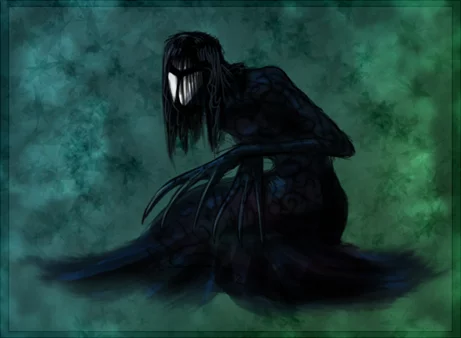
Custom Conjured Sluagh
Sale: $16.00
Save: 94% off
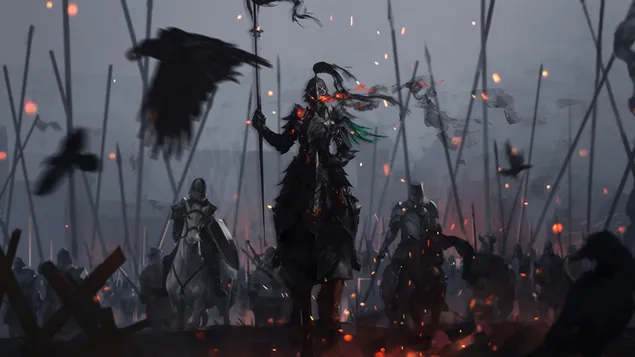

Featured [more]
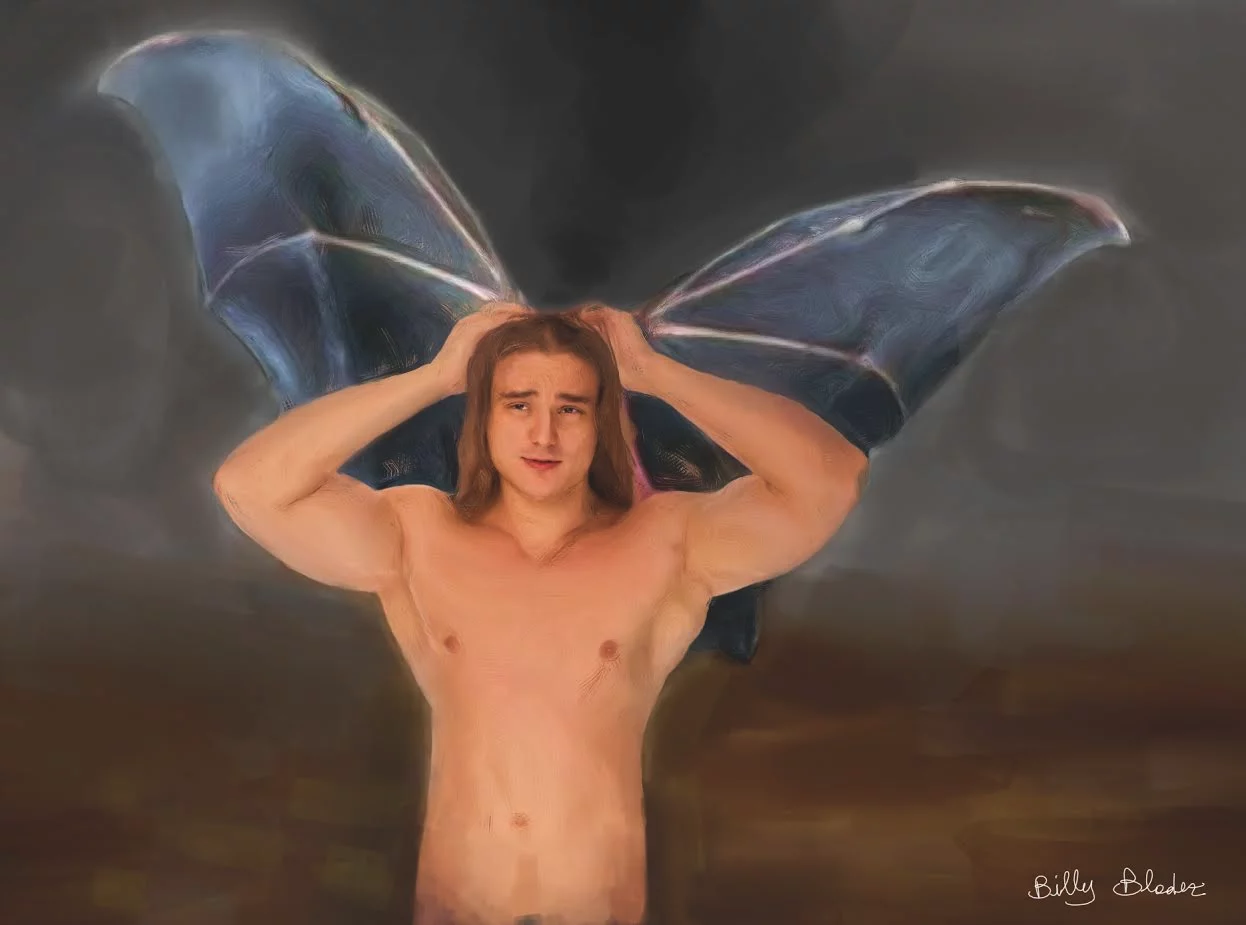
Custom Conjure DA Incubus Sex Spirit
Sale: $10.00
Save: 94% off

Custom Conjure Bound WA Spirit or Entity
Sale: $10.00
Save: 94% off
Aswang in Philippine Folklore and Spirit Work
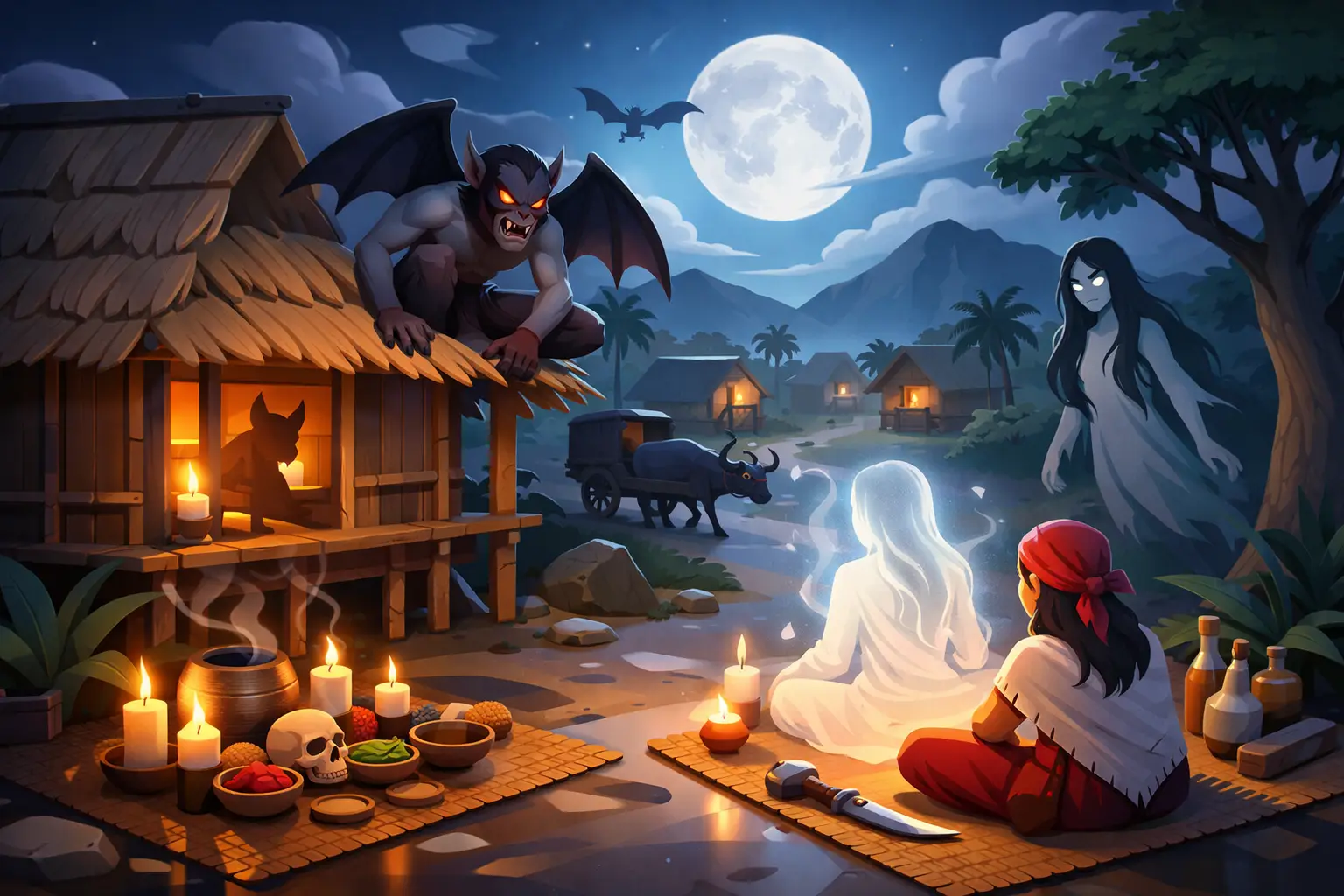
A cry beyond the tree line. A neighbor who seems different after nightfall. A warning spoken softly to keep children close to home. The aswang is not one neat creature from a single fixed story. It is a powerful and shifting presence in Philippine folklore, shaped by region, family memory, fear, survival, and the unseen.
For spirit keepers and occult practitioners, that complexity matters. The aswang should not be reduced to a spooky aesthetic, a monster label, or a casual stand-in for every predatory spirit. Approaching this lore with discernment creates room for meaningful study, stronger energetic boundaries, and deeper respect for the cultures that have carried these stories across generations.
What Is an Aswang?
In the broadest sense, aswang is an umbrella term used in the Philippines for a range of feared supernatural beings, witches, shape-shifters, and nocturnal predators. The exact meaning changes from one island, province, and storyteller to another. A being called aswang in one community may have a different nature, name, appearance, or ritual context elsewhere.
Many accounts describe the aswang as human by day and dangerous by night. Some are said to shift into animals such as birds, dogs, pigs, or large black creatures. Others are associated with witchcraft, graveyards, illness, hunger, or attacks on the vulnerable. Their stories often carry a clear message: pay attention to what enters your home, honor the wisdom of elders, and do not ignore the feeling that something is wrong.
That does not mean every story is meant as a literal field guide to a single species of entity. Folklore can preserve spiritual belief, yes, but it also holds social fears, protective customs, local history, and warnings designed to help a community endure. The most respectful approach is to let the tradition remain layered.
The Many Faces of Aswang Lore
The word becomes more meaningful when we stop expecting one universal description. Several figures are often discussed under the aswang umbrella, though their roles vary widely by region.
A manananggal is perhaps one of the most recognized forms in popular retellings: a being said to separate at the waist and fly through the night, searching for prey. The tik-tik is associated with an eerie birdlike call, sometimes believed to mislead listeners about how near danger may be. A mangkukulam is linked with sorcery and hexing, while a mandurugo may be described as a blood-drinking figure. Other stories focus on corpse-eaters, animal shifters, or malicious beings who disguise themselves in ordinary human life.
These categories can overlap. They can also be altered by films, urban legends, tourism, colonial records, and retellings from people outside the communities where the lore began. Treat any quick definition as a starting point, not a final verdict.
Why the Stories Feel So Charged
Aswang stories sit close to practical fears: sickness with no obvious cause, pregnancy and childbirth, death, isolation, hunger, betrayal, and the vulnerability of children. In a world before modern medical access and instant communication, stories could teach vigilance in a form that people remembered.
They also reveal a spiritual truth familiar to many practitioners: not every presence that appears beautiful, intriguing, or powerful is aligned with your well-being. Discernment is not paranoia. It is a devotional practice of listening to your body, honoring your wards, and refusing contact that leaves you depleted, frightened, or pressured.
Aswang and Spirit Keeping: Respect Before Curiosity
For those drawn to spirit companionship, the first question should not be, “How do I get one?” A better question is, “What am I actually seeking, and am I approaching this tradition with integrity?” Curiosity about dark folklore can be healthy. Treating a culturally specific feared being as an accessory, however, is not the same thing as serious spiritual practice.
The aswang is not a generic category for any Dark Arts companion, psychic predator, vampire, witch spirit, or shapeshifter. Those distinctions matter. A responsible conjuror works from clear identification, consent, appropriate boundaries, and an understanding of the being or current involved. They do not use a dramatic folklore label simply because it sounds intense.
If a listing, reading, social media post, or supposed encounter uses the word aswang, ask for clarity. What regional tradition is being referenced? Is the term being used in a historical, folkloric, or spiritual sense? Is there a specific entity type being identified, or is the label being used loosely? Vague claims are not automatically malicious, but they are a reason to slow down.
A personalized spiritual path is not built by collecting the most intimidating names. It is built through energetic alignment, self-knowledge, protection, and relationships that support your stated intentions. For one practitioner, that may mean ancestral healing. For another, it may mean warding, shadow work, or learning to trust their intuition without feeding fear.
Protective Wisdom Found in Folklore
Even when you approach aswang accounts as folklore rather than literal encounter reports, the protective customs around them can inspire grounded spiritual reflection. The point is not to imitate practices you do not understand or claim traditions that are not yours. The point is to recognize the enduring human need for spiritual safety.
Begin with your own house and your own energy. Keep your ritual space clean. Refresh protections instead of assuming last month’s work will hold forever. Be selective about what you invite into your practice, especially when grief, loneliness, anger, or desperation make any offer of power seem tempting.
Strong boundaries can be simple and firm. State that only benevolent, verified, and invited energies may enter your space. Cleanse after difficult readings, nightmares, arguments, or heavy social environments. Journal repeated impressions before deciding they are messages. If an experience is causing severe distress or disrupting sleep, relationships, or daily functioning, seek grounded support from a qualified health professional alongside any spiritual care.
Protection is not about living in fear of every shadow. It is about becoming difficult to confuse, manipulate, or drain. A well-tended altar, a trusted protective companion, regular cleansing, and clear spiritual house rules can make a practitioner feel more centered and less vulnerable to sensational claims.
Avoiding the Trap of Fear-Based Spirituality
Fear sells quickly. It can make any strange sound seem like a sign, any nightmare seem like an attack, and any difficult season seem like proof of a curse. Aswang lore is compelling precisely because it touches primal fears, but a mature occult practice does not need to inflate those fears.
Discern between a meaningful spiritual signal and ordinary life. A creaking roof may be a creaking roof. Exhaustion may be a sign that you need rest, nourishment, or medical care. At the same time, if you repeatedly feel spiritually unsettled, do not dismiss yourself. Observe patterns, reinforce boundaries, and consult a practitioner whose work is transparent rather than theatrical.
The most trustworthy spiritual guidance leaves you with more agency, not less. It does not insist that you are helpless without an expensive emergency intervention. It does not demand secrecy, isolate you from practical support, or use terror to force a purchase. Real energetic work can be intense, but it should still honor your consent and your capacity to choose.
A Respectful Path Forward
Studying aswang lore can deepen your understanding of how communities name danger, protect the vulnerable, and make sense of the unseen. It can also sharpen your own spiritual instincts. The lesson is not that every unknown presence is an enemy. The lesson is that names carry histories, and spiritual power asks for discernment.
At The Pagan Shop Online, we believe meaningful spirit work begins with energetic fit, clear intention, and respectful practice. Whether you are seeking protection, psychic development, healing, or a deeper relationship with your own intuition, choose paths that make you more present in your life and more accountable to your values.
Let the stories of the night remind you to tend your wards, listen carefully, and keep your spiritual doorways intentional. Curiosity is sacred when it walks beside respect.

Important Links
- Spirit Companion Codex
- The PaganShopOnline.com's Circle of Conjurors
- The PaganShopOnline.com's FAQ's
- Transparency in Spirit Conjuring: Ethics, AI and Integrity
- Spirit Matching Quiz ( Help Find the Best Beings for You)
- Pagan Shop Online Chatroom
- The Pagan Shop Online Forum
- ThePaganShopOnline's Blog
- The Conjuror’s Eye: An Exclusive Pagan Shop Experience
- The Conjuror's Deck: An Exclusive Pagan Shop Experience
- The Conjurors Insight: An Exlusive Pagan Shop Experience
- The Conjuror's Oracle: An Exclusive Pagan Shop Experience
- The Conjuror's Board: An Exclusive Pagan Shop Experience
- The Conjuror's Numerology Matrix An Exclusive PS Experience
- The Conjuror's Stones An Exclusive Pagan Shop Experience
- The Conjuror's Horoscope An Exclusive Pagan Shop Experience
- The Conjuror's Mirror A Exclusive Pagan Shop Experience
- The Conjuror's Dream Interpreter An Exclusive P. Shop Experience
- Sigil Maker
Reward Points
Log in to see how many reward points you have already earned
Sponsors
 |
Bestsellers
- In-Depth Reading of your spirit
- Custom Conjure Royal(Monarch)...
- Spirit Picture Upgrade From Basic...
- DA/WA Spirit/Entity Reverse...
- Custom Conjure Bound DA Spirit or...
- Ultimate Add On Spirit Package
- 3 body Binding Add-On Spirit,Astral...
- 2 body Spirit Binding
- Reverse Adoption for Gifted Humans
- DA Demonic Reverse Adoption by...